The salient feature of computers is that they manipulate physical information. Both you scribbling on a piece of paper when doing simple calculations and your computer modifying its memory by means of electrical signals are essentially doing the same thing.
It might at first appear that computation requires humans, their brains or their inventions, but it actually precedes us by quite a while.
The first computer
Any computation, however it is realized in the physical world, needs a medium to store the intermediate results and a means for manipulating that medium. The first computers were both: long molecules with the ability to copy themselves. They quickly proliferated but since this was a probabilistic chemical process it erred occasionally, introducing variation and competition. The inefficient or unstable molecules were eliminated leading to continuous growth of complexity.
But do we have any evidence for this story?
The other nuclear power
Recall that RNA is a long chain of nucleotides that serves, among other things, as an intermediary when translating the information stored in the DNA to proteins. Unlike DNA, it also has many functional roles. For example ribosomes, the units that translate RNA to proteins, are themselves made of RNA. This is possible because RNA tends to occur as a single strand and so can fold back on itself to create complex 3d structures.
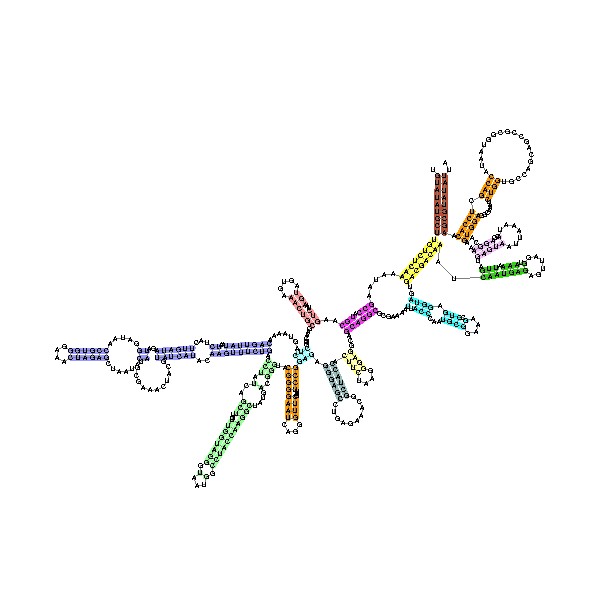
So RNA can serve some of the functions of both the DNA and proteins and it’s conceivable that a long time ago it was completely self-sufficient, a scenario expressed in the RNA world hypothesis. On this account, RNA was exactly the molecular computer I described in the previous section.
The machine grows
Things have changed since then—RNA gradually gave up most of its functions because more efficient methods were found. Proteins largely replaced its role in metabolism. DNA took its place of a durable storage of information. And cells developed to protect these systems and find new ways of exploiting the environment.
Now, if a cell is a computer what is it computing? Indeed, its genetic memory does not change during its lifetime and a computer that cannot modify its memory is rather useless. The answer is we need to take a bigger picture, an evolutionary one, and look at a lineage of an organism.
Computing across generations
Consider a bacterial clone. All the cells in it are largely identical because they share a recent ancestor but every individual is unique because of mutations. We’ll consider the collection of all the genetic information its memory. This memory is operated on by life itself—every time a new cell is born, the memory expands; every time a cell dies, it shrinks. The contents of this memory are very specific: they express the instructions for building cells and running all the processes that make them survive and reproduce in the given environment.
The following video demonstrates the computation of antibiotic resistance by means of controlling the environment.
We can push this observation much further to direct the evolution itself and produce completely new desirable materials.
Computation across species
The above picture of asexual reproduction and mutation is a good starting point when discussing biology. But even bacteria themselves are way more inventive than that—they can conjugate and exchange genetic information or exploit viruses toward the same purpose. Other organisms developed sex and many chromosomal rearrangements. Some of them standard, like crossover, others accidental, like fusion that produced human chromosome 2 from two ape chromosomes. All for the sake of expanding the range of operations on the genetic memory. And to top it off viruses can carry genetic material between species and even integrate it back into the host’s genome.
Life is the most wonderful computation.