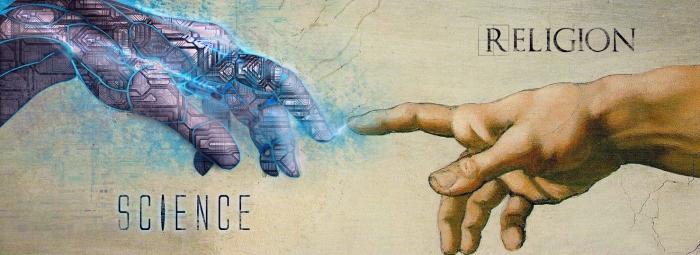
Science and religion seem irreconcilable on their face: one requires evidence, the other faith. But this is an extremely superficial view and everyone would benefit if we could bring these worlds closer together.
That being said, as a faithless creature I can only provide one side of the picture, approaching religion from a scientific vantage.
Why religion exists
I can’t possibly enumerate all of the reasons but I can suggest why religion seems to be such a universal feature of human civilizations.
Spirituality
First, we are not even close to analytical machines—we emerged from a long and meandering evolution and are being reigned by many emotions and subconscious processes the purpose of which we don’t quite understand.
In particular, there’s a whole host of spiritual states we can experience. These can be accessed in all sorts of ways—be it art, meditation, or psychedelics—but their mere possibility hints that we’re biologically pre-programmed for something like religion.
Rules
Life is tough. How do we know what’s right and what’s wrong? In some cases the answer is obvious, do the things which are aligned with our biology—avoid pain and seek pleasure. But this is not going to work if what you do conflicts with the desires of others—that’s why we have cultural norms and law. But where have they come from?
Game theory, especially its evolutionary facet, paints a rather clear picture. It starts by modeling society as a collection of interacting agents with certain strategies; some of them are selfish, others altruistic, and yet others mixing the two approaches in a clever way. We let these agents play for some time and see how well they fare. Very few assumptions are put in but after a while you see all kinds of patterns emerge.

This is not to say that any particular model can capture the intricacies of human relations. Rather, socially beneficial rules can appear through natural selection in the domain of culture—certain rules will make their followers more effective than if they followed pure reason and as a result those effective rules will spread.
Because this was a long time ago, these rules were expressed in the form of stories and other rhetorical devices so that they could be preserved across generations. Then at some point somebody wrote the stories down and they gradually became sacred.
I don’t mean to disparage religion here, quite the contrary. Much like we were given a marvelous body we don’t need to understand to be able to run and laugh and love, so we have inherited a wonderful collection of rules we don’t need to grasp to be able to lead a good life by following them.
Meaning
Humanity is a precarious condition. We are creatures half biological, half cultural, and half rational—which doesn’t quite add up. Genes care about you only insofar as you help them replicate, whether that’s your own reproduction or helping the genes of your relatives; likewise with memes feeding on your brain.
But if genes don’t really care about you, why should you care about them? Why procreate when you can have fun instead? So with culture, why shouldn’t your reject it and find your own meaning? But it’s not clear how you’d go about finding it in the infinite space of possible actions. Religion can help narrow it down.
Scaling up
While religion might be useful to individuals it is arguably even more important for groups and societies.
There is evidence that religion, especially monotheistic religion, is what really kindled our civilization. Our ancestors had lived in hunter-gatherer tribes and these still exist all around the world; so we can study them. What you see is that they do not progress to form larger groups, they don’t trust each other. But religion can help us put those differences aside—it can provide superior rules for cooperation and unite people through the common belief framework and spiritual experience.
A wrinkle
Despite all the wonderful aspects of religion it’s not without its faults. The rules we’ve been handed, which tend to work quite well, were created thousands of years ago and it’s not clear to what degree they still match our modern environment.
This is where science can help. After all, we all want to flourish and we should use all the tools we have at our disposal. We don’t need to cling to ancient sentences, some of which no longer make any sense today. I believe this is what reasonable religious people actually do, by interpreting problematic parts metaphorically in the light of modern evidence and experience. And as far as I’m concerned, this is exactly the right way to proceed.
My only beef with religion is that people tend to become dogmatic and insist on literal interpretation of clearly nonsensical beliefs (Earth was created 6000 years ago). But dogma is omnipresent, even in science, so this is a failure of rationality, not a failure of religion per se.
There have also been numerous atrocities committed in the name of various gods but we are perfectly capable of the very same crimes without any religion in sight.
Confession
I wouldn’t mind to be religious—strong faith and a rational mind is a recipe for a great life. I don’t think that’s a possibility for me in this life anymore but I’m convinced there’s a plenty of useful stuff for me to uncover through the study of religion.
So help me God.